Showing posts with label nature journal. Show all posts

Wednesday, May 2, 2012

The Iris

Iris is a genus of approximately 260 flowering plants that come in many different colors. In fact, it takes its name from the Greek word for "rainbow". The iris is a good example of the special relationship flowers have with pollinating insects. Its three downward facing petals form a doorstep for a bee while the three upward thrusting petals form an archway. As the insect enters the flower to get to the nectar it brushes against the pollen with its back thereby ensuring pollination of the iris as the insect flies from flower to flower looking for more nectar.


An Iris Blessing


May your blooms be floriferous and in good form,

Distinctive, with good substance, flare, and airborne,

With standards and falls that endure, never torn.

May you display many buds and blooms sublime,

In graceful proportion on strong stalks each day,

Gently floating above the fans and the fray.

May you too reach toward the moon and stars,

Bloom after bloom, many seasons in the sun,

Enjoying your life, health, and each loved one,

Until your 'living days are artfully done.

By Georgia Gudykunst


Saturday, April 21, 2012

Nature Study- Bleeding Heart

Japanese Bleeding Heart- Dicentra Spectrabilis
 Bleeding Heart is a perennial that is native to woodlands.
 They are called Bleeding heart because of the heart-shaped petals that look like they have a drop of blood at the bottom.
 Bleeding heart has fern-like foliage.
 Bleeding Heart is a relative of Dutchman's Breeches (Dicentra cucullaria)
Don't eat! Bleeding Heart is poisonous if ingested.
I'm not much of a flower-arranger but was happy with the vase of Bleeding Heart, Dogwood and Azalea.
Thanks to Mimi for the flowers!

Tuesday, February 28, 2012

Beavers


We just read about Beavers in our Zoology book and this is what we learned: (narrated to Mom by the four kids....)


1. If somebody wrecks a beaver dam, they can rebuild it in a day.
2. Beavers eat wood.
3. They live in a lodge.
4. Beavers store wood underwater for food in the winter
5. Beavers change their environment more than any being except for humans.
6. Beavers make dam in order to make a pond.
7. A beaver is a rodent. All rodents have four front teeth that they keep short by chewing on wood and nuts.
8. They can chew down trees with their teeth.
9. Beavers have webbed feet and a flat tale. This makes them good swimmers.
10. The biggest beaver dam ever found was 2,000 feet long, 28 feet wide at it's base and 14 feet high.


We also watched a documentary about Beavers on Netflix...


Tuesday, February 7, 2012

Skunk Cabbage

Today we were reading The Witch of Blackbird Pond by Elizabeth George Speare. Skunk Cabbage was mentioned as a medicinal remedy for asthma and then I remembered that skunk cabbage grew at our local nature center so we set out to find some. This is what we found:


Skunk cabbage (Symplocarpus foetidus) prefers wetlands and is considered a harbinger of spring. At first only the flower shows above the mud with stem still buried beneath the ground. The mottled purple part of the plant is called the spathe. The knoblike structure is called the spadix.

The skunk cabbage gets its name from the pungent odor that it gives off. The odor serves to attract pollinators such as bees and flies while also deterring animals that might think about eating it.


Thursday, December 22, 2011

The Poinsettia- Nature Study


The poinsettia is native to Mexico and is named after the first U.S. foreign minister to Mexico, Joel Poinsetts, who introduced it here in 1825. In Mexico, it is called the Noche Buena. The poinsettia has dark green leaves and also colored leaves called bracts. People usually think that these are the petals of the flower (I know that I did) but they are actually just colored leaves, while the flowers are the small yellow buds in the center of the plant called cyathia. The Aztecs used the plant for red dye. The association of the plant with Christmas began with a legend dating back to Mexico in the 1500's. You can read about it in The Legend of the Poinsettia by Tomie de Paola.

Monday, December 5, 2011

Christmas Nature Study: Spices

We had some friends over today and we were doing some baking. The recipe called for cloves so I was showing the girls how to crumble to cloves into the batter when I thought, "Where do cloves come from?".
So, we did some research and found out that what we call cloves are the dried flower bud from the clove tree which is an evergreen tree native to Indonesia.Which led me to the question- Where do cinnamon, nutmeg and ginger come from?


Well, I tend to think of ginger as a root but it is actually a rhizome or an underground stem which can shoot out roots. It is used as both a spice and for medicinal purposes. It was first cultivated in South Asia.


Cinnamon is a spice derived from the inner bark of the Cinnamomum tree. It is cultivated in Sri Lanka, Southern India and many other parts of the world- Brazil, Sumatra and Egypt to name a few.


The nutmeg tree is native to Indonesia and produces two spices: nutmeg and mace. The spice that I use called nutmeg is actually the ground up seed of the nutmeg tree. Mace is made from the red strands covering the seed.


So, now we know. The illustrations come from a book called Koehler's Medicinal Plants. What a great resource for nature study! It is rare- otherwise I would love to own it.

Thursday, November 10, 2011

Otters!


We read all about otters and then we played the narration game. We go around the table from youngest to oldest (including Mom) and share a fact that we remember from our reading. Here is what we came up with for otters- I think we went around the table four times.

Otters have air in their fur to keep their skin dry.
Otters use a rock to break open their food.
They use their stomachs to carry food and their babies.
Their home is called a holt.
Sea otters wrap themselves in kelp when they sleep so they don't float out to sea.
Otters like to play.
Their babies can float then they are born but they cannot swim.
A Romp is an otter clan.
Freshwater otter's babies stay in the holt for several months.
There are many kinds of otters- like freshwater and saltwater.
A long time ago, an explorer crashed and survived by killing otters and discovered that their fur was very warm.
In South America, there are otters that can grow up to six feet.
Otters are carnivorous.
Otters are one of the few animals that use tools.
Otter skins, at one time, were worth a lot of money.
Otter skins were very popular in China.
Otters were on the endangered species list.
Otters really like kelp forests because of all the different types of animals that hide there that they can eat.
Otters are in the mustelidae family.

Then we met some friends at the Boonshoft to play and the observe the otters. It was really fun because we came at feeding time so we saw lots of action. There are three otters at the Boonshoft and their names are: Glider, Diver and Slider.


Thursday, October 13, 2011

Spiders

A Wolf Spider
An orb spider web

1. Spiders have light blue blood.
2. Some spiders have big spines.
3. Some spiders have fangs.
4. There are four kinds of webs- sheet, dome, orb and funnel.
5. A spider's eggs are very small.
6. A spider spins a web so that it catch food for it to survive.
7. The web is really sticky so when a fly flies into it, it will get stuck and then the spider eats it.
8. Some spiders can camoflauge and they blend in and jump up and catch bugs to eat.
9. The trapdoor spider makes a hole in the ground . He hides in the whole and when a bug comes, he jumps out and grabs it. If he doesn't like it, he throws it out.
10. Some spiders live under water. Their webs are full of air.
11. A spider has eight legs and eight eyes.
12. Spiders can live in the desert, forest and some even live in our house!
13. Baby spiders are called spiderlings.

By Adam (dictated to Mom)

Sunday, October 2, 2011

September Nature Study- Lake Superior Beach Stones

We collected tons of rocks when we were on vacation this summer at Lake Superior.
Some of our collection....
A nifty little book that I picked up- beautiful illustrations!
Adam drew gneiss in his nature journal. Gneiss is a metamorphic rock and similar in appearance to granite but it is distinguished by it's bands of colored minerals.
We read about the three types of rock: igneous, metamorphic and sedimentary. Also our book explained that the difference between a rock and mineral is that minerals are naturally occurring solid substances while a rock is made up of different types of minerals.

Thursday, May 5, 2011

Mushrooms

We are going mushroom hunting this weekend so in anticipation, we did a brief Nature study on mushrooms. One of the first things that we learned is that mushrooms are a type of fungi. Some fungi are parasites which means that they steal food from a living plant and some fungi are saprophytes which means that they live off the remains of dead plants. Many types of mushrooms are edible but some are poisonous. Here are some ways to tell if a mushroom is poisonous:
1. They have scales.
2. The base of their stem is contained in a sac.
3. They have milky juices.
4. They have shiny, thin or brightly colored caps.
5. They have whitish or clay colored spores.

Whew! Good thing that we are going hunting with some experts. I'd probably be too nervous to hunt mushroom on my own....


Adam's drawing

My drawing

Thursday, April 28, 2011

The Crawdad

Last week, we had some friends over for a Nature Study Lesson about the crawdad. Here is Ethan's drawing:


Facts We Learned About the Crawdad:

1. If a crawdad loses an appendage, it will grow back. (Hannah)
2. It has pincers, antennae, carapace, eyes and three jaws to chew their food. (Adam)
3. It has five pairs of legs, three of which have pincers. (Hannah)
4. Crawdads have spinnerets on the underside of their bodies which help them move. (Mom)
5. Crawdads are invertebrates which means that they don't have a backbone. (Caleb)
6. Crawdads have an exoskeleton which is their shell. (Mark)
7. A crawdad molts which is shedding the old shell and growing a new one. (Ethan)

Tuesday, February 1, 2011

At Our Birdfeeder: Starlings


By Adam age 7


We have had a new bird at our birdfeeder: the European Starling. The European Starling is not native to North America. It was introduced in New York in the 1920's by a man who had the idea to bring all of the birds mentioned by William Shakespeare to North America.

“When he lies asleep,
And in his ear I’ll holla ‘Mortimer!’
Nay,
I’ll have a starling shall be taught to speak
Nothing but ‘Mortimer,’ and give it him,
To keep his anger still in motion.”
[1st Henry IV – I, 3]


Here are our paintings of the European Starling:


by Ethan age 8

by Abigail age 4
She decided to make a cardinal with spots instead. She declared the
blue object to be a mailbox.

By Caleb age 10

By Mom


You can find out more information about the European Starling here. Several times this winter, we have noticed large swarms of birds sitting on power lines. I did some research and I think that these are starlings. So, now you know.


Thursday, January 20, 2011

Our Book of Centuries and Family Nature Journal


There are two projects that I have wanted to do for a long time and they are finally under way!

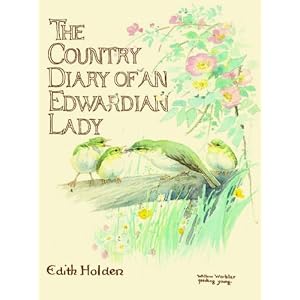
I love The Country Diary of an Edwardian Lady by Edith Holden. It is her nature journal from the year 1906. It is filled with watercolors of plants and animals as well as quotes and poetry about the months and seasons. It's inspiring and for several years one of my New Year's resolutions has been to do my own version. I have decided that maybe that is not realistic for the time being. So the Family Nature Journal is the compromise. It is divided into twelve sections- one for each month. I have gone back and scanned some of our drawings from previous year and put them on pages together according to what month they were done. Then I printed out the page and filed it in the section of our binder for that month. This is working nicely because then the kids' journals stays intact but we also have a place to display what's been done. I'm hoping that in a few year's time we'll have something that we can really enjoy. Here's one page:


Also, we are finally working on a Book of Centuries. I know there are many ideas out there for how this should be done. Here's how we are doing it:
1. I copied this template from simplycharlottemason.com.
2. I punched holes in it and put it in a binder.
3. We drew pictures and printed out some pictures for important events and people that we would like to include. I am using 2 1/2 x 3 inch notecards. These are awesome- more on that later.
4. We put a title and date for the event or person on each card. (We are also putting all of the artists and composers that we have studied in the past as well as some historical events.)

5. We are in the process of gluing these down on their appropriate pages. This will be ongoing as we will add more as we further our studies. I think Friday morning will be the designated time for the Book of Centuries, along with piano lessons, updating our book logs and completing any unfinished work.

I think that it takes me a LONG time to figure out how I want to organize things. Hopefully these will both pass the test of time.

Friday, October 29, 2010

Milkweed and the Monarch


We have been continuing our study of the Milkweed plant. This week we learned about it's very special relationship with the Monarch butterfly. From June through August, the adult Monarch sips the nectar from the flowers of the milkweed plant and the female deposits her eggs on its leaves. The egg becomes a caterpillar which feasts on the leaves of the milkweed plant. There are very few insects which can safely feed on the Milkweed plant as it is toxic to most species. This makes the caterpillar a nasty morsel for predators and so it is mostly left alone. Other insects that can eat Milkweed are the Milkweed Bug and the Milkweed beetle. Once the caterpillar has eaten enough it hangs upside down from a leaf of the Milkweed plant, forms itself into a J-shape and forms it's own chrysalis. After twelve days, a Monarch butterfly emerges and because it ate the milkweed plant as a larva, it is still slightly toxic and predators learn to leave it alone. The Monarch then migrates over 2, 000 miles to Mexico where it spends the winter. In the spring it returns north to the Milkweed plant. Amazing!

From a previous post:
Milkweed is a common perennial which is native to North America It is given its name because of the milky white sap that oozes from the stem and leaves when they are cut or crushed. It has large tear drop shaped seed pods which turn brown as they mature and then split open releasing the seeds which are attached to a tuft of silky hair. This hair helps the seed to be scattered by the wind. The floss, or hair, of the milkweed is five times more bouyant than cork and six times lighter and warmer than wool and is used for stuffing pillows, mattresses and life jackets.

Other cool facts about Milkweed:
It's sap (or "milk") was used by pioneers to cure warts.
It's seed tufts were used by Native Americans to insulate moccasins!


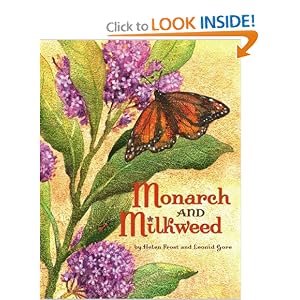
We found a great book called Monarch and Milkweed by Helen Frost.
Check this out too!