Showing posts with label poetry. Show all posts

Wednesday, September 12, 2012

Mama's birthday

Poetry, hiking, reading books, pizza, pumpkin candles.....it was fun!


You teach us how to read and write
Whenever we eat you take a bite

You make lots of smoothies for us to drink 
You drill us hard you make us think

You cook our food and it is so great
 Except for broccoli which we really hate

You drive us to tons of places 
So that we get to see a lot of faces

You are mom and we love you most

We also love your great pot roast
- Caleb


Roses are red and violets are blue 
You are my mom and I love you

I love your kisses and your hugs 
It's good they don't come with bugs
- Abby Jane


You are a mom who is so cool 
You also love to teach us school

You make an awesome chocolate cake 
 I also love to help you bake

You do not like our stinky shoes 
But are there for us when our game we lose

You do not like it when we forget our stuff
And sometimes you just huff and puff

I love you most when you read me books
And make sure I have good looks
- Ethan


I really really like your chilli
Even better than meatloaf with Uncle Billy

You don't like to wash our dishes
But you listen to our wishes

You take us to our baseball  games 
You cheer us on and say "Good game"

You take us out on lots of hike 
And we really like to our bikes

I love you and you are the best 
And I love your hugs before I rest
- Adam


Saturday, April 28, 2012

Emily Dickinson


Emily Dickinson was born in Amherst, Massachusetts on December 10, 1830. She was the middle of three children and was considered well-liked and attractive. For some reason, she cut herself off from society in her late-twenties. She dressed only in white and rarely left her home. Emily was a prolific writer of poetry but less than ten of her poems were published in her lifetime. Her sister, Lavina, found a drawer full of Emily's poems after her death in 1886. Lavinia published a book of Emily's poems in 1890 and now she is considered one of America's best loved poets.

We have learned that Emily didn't give titles to her poems and also at times employed a technique called "slant rhyme". This means that the last letters of two words might sound the same but the vowel sound is different so the words don't quite rhyme but they mostly do (thing, sang) . Another example would be the vowels are the same but the ending consonant is different (dark, heart).

We have been reading through a book of Emily's poems as well as some fictionalized children's books about Emily's life. Here are some of the books that we have read as well as a few of our favorite poems:


 The Mouse of Amherst 
A mouse named Emmaline moves into the Dickinson home and trades poems back and forth with Emily.

 Emily and Carlo
This book tells the story of Emily's beloved pet dog, Carlo.
 Letters to the World
A collection of several of Emily poems
My Uncle Emily
A story about Emily Dickinson told through the eyes of her nephew, Gilbert.


 And a few poems: 

I started Early – Took my Dog –
And visited the Sea –
The Mermaids in the Basement
Came out to look at me –


And Frigates – in the Upper Floor
Extended Hempen Hands –
Presuming Me to be a Mouse –
Aground – opon the Sands –


But no Man moved Me – till the Tide
Went past my simple Shoe –
And past my Apron – and my Belt
And past my Boddice – too –


And made as He would eat me up –
As wholly as a Dew
Opon a Dandelion's Sleeve –
And then – I started – too –


And He – He followed – close behind –
I felt His Silver Heel
Opon my Ancle – Then My Shoes
Would overflow with Pearl –


Until We met the Solid Town –
No One He seemed to know –
And bowing – with a Mighty look –
At me – The Sea withdrew –

Another poem:

I'm nobody! Who are you?
Are you nobody, too?
Then there's a pair of us--don't tell!
They'd banish us, you know.

How dreary to be somebody!
How public, like a frog
To tell your name the livelong day
To an admiring bog!

Here's a link for a madlib of Emily's Nobody poem.

And another: 
Tell all the Truth but tell it slant --
Success in Circuit lies
Too bright for our infirm Delight
The Truth's superb surprise

As Lightning to the Children eased
With explanation kind
The Truth must dazzle gradually
Or every man be blind --
     
Excerpts of other poems we have like but are mentioned elsewhere in our blog...

-Hope is the thing with feathers that perches in the soul....

-There is no frigate like a book to take us lands away....

-I dwell in possibility, a fairer house than prose....

Tuesday, March 27, 2012

Anne of Green Gables

We have started reading Anne of Green Gables by L.M. Montgomery. We are enjoying it and laughing at Anne's dramatic view of the world. Here are some quotes that we have been enjoying:

Scope for the imagination
The white way of delight
The lake of shining waters
A kindred spirit
The depths of despair
Anne spelled with an e
My life is a graveyard of buried dreams

We read this poem by Emily Dickinson today and thought that Anne would like it:

I dwell in Possibility--
A fairer House than Prose--
More numerous of Windows--
Superior--for Doors--

Of Chambers as the Cedars--
Impregnable of Eye--
And for an Everlasting Roof
The Gambrels of the Sky--

Of Visitors--the fairest--
For Occupation--This--
The spreading wide my narrow Hands
To gather Paradise--


Saturday, March 10, 2012

Having Fun Late Winter 2012

Pictures of random fun things we've been doing lately....

There have been a lot of puzzles lately- especially with Ethan, Adam and Daddy. Here is one about birds.
The weather has been conducive to more nature hikes. I'm not sure what Ethan is intending to do with his wood....
We find these sometimes but don't know what they are. Its a seed pod of some sort about the size of a walnut but you can crush it in your hand and it looks like this. 
Climbing
"Take a picture of me, Mom!"
My kid who likes painting the best.
The baker making brownies for Teatime
The brownies
Teatime photos

Another puzzle- Neuschwanstein.

Tuesday, February 7, 2012

Henry Wadsworth Longfellow


Our poet for this term is Henry Wadsworth Longfellow (1807-1882) and we have been gradually working our way through a book of his poems. Longfellow was an American poet  known for his lyrical style. Some of his best know poems are: Paul Revere's Ride, Hiawatha's Childhood, A Psalm of Life and Christmas Bells. 


Today we enjoyed this poem: The Tide Rises, The Tide Falls


The tide rises, the tide falls,
The twilight darkens, the curlew calls;
Along the sea-sands damp and brown
The traveler hastens toward the town,
And the tide rises, the tide falls.


Darkness settles on roofs and walls,
But the sea, the sea in darkness calls;
The little waves, with their soft, white hands
Efface the footprints in the sands,
And the tide rises, the tide falls.


The morning breaks; the steeds in their stalls
Stamp and neigh, as the hostler calls;
The day returns, but nevermore
Returns the traveler to the shore.
And the tide rises, the tide falls.


To me, there was a sense of breathing inherent in the rhythm of this poem. Then, because we don't live anywhere near the ocean, and so a few of my kids didn't understand what a tide was, we watched the following:


My favorite Longfellow quote is:


"Music is the universal language of mankind."

Thursday, October 27, 2011

The Barefoot Boy by John Greenleaf Whittier

The post below reminds me of my grandfather calling my cousin, "barefoot boy, with cheek of tan". Now I know that line comes from the following poem. He must have memorized it in his childhood. Here is an excerpt:


The Barefoot Boy


Blessings on thee, little man,
Barefoot boy, with cheek of tan!
With thy turned-up pantaloons,
And thy merry whistled tunes;
With thy red lip, redder still
Kissed by strawberries on the hill;
With the sunshine on thy face,
Through thy torn brim’s jaunty grace;
From my heart I give thee joy,—
I was once a barefoot boy!
Prince thou art,—the grown-up man
Only is republican.
Let the million-dollared ride!
Barefoot, trudging at his side,
Thou hast more than he can buy
In the reach of ear and eye,—
Outward sunshine, inward joy:
Blessings on thee, barefoot boy!

Oh for boyhood’s painless play,
Sleep that wakes in laughing day,
Health that mocks the doctor’s rules,
Knowledge never learned of schools,
Of the wild bee’s morning chase,
Of the wild-flower’s time and place,
Flight of fowl and habitude
Of the tenants of the wood;
How the tortoise bears his shell,
How the woodchuck digs his cell,
And the ground-mole sinks his well;
How the robin feeds her young,
How the oriole’s nest is hung;
Where the whitest lilies blow,
Where the freshest berries grow,
Where the ground-nut trails its vine,
Where the wood-grape’s clusters shine;
Of the black wasp’s cunning way,
Mason of his walls of clay,
And the architectural plans
Of gray hornet artisans!
For, eschewing books and tasks,
Nature answers all he asks;
Hand in hand with her he walks,
Face to face with her he talks,
Part and parcel of her joy,—
Blessings on the barefoot boy!


When the Frost is on the Punkin

We are working on this poem by the "Hoosier Poet", James Whitcomb Riley.
Also, fodder is farm animal feed and shock refers to the corn in the fields which is gathered into tall tent-like structures.

Thursday, July 21, 2011

Maxfield Parrish


At the beginning of the summer, we enjoyed a book called: Maxfield Parrish : a treasury of art and children's literature compiled by Alma Gilbert. Parrish (1870-1966) was an illustrator around the turn of the 20th century. Above is my favorite Parrish illustration, Lantern Bearers. Anyway, I love the luminosity in his paintings which he accomplished through a fairly complicated process of alternating many layers of thin paint and varnish over stretched paper. Here are some examples of his work:

Sleeping Beauty
The Reluctant Dragon

King of the Black Isles
from Arabian Nights
(If this looks familiar, Enya used this pose for the cover of one of her albums)

The Sugar Plum Tree

By Eugene Field

Have you ever heard of the Sugar-Plum Tree?

'Tis a marvel of great renown!

It blooms on the shore of the Lollipop sea

In the garden of Shut-Eye Town;

The fruit that it bears is so wondrously sweet

(As those who have tasted it say)

That good little children have only to eat

Of that fruit to be happy next day.


When you 've got to the tree, you would have a hard time

To capture the fruit which I sing;

The tree is so tall that no person could climb

To the boughs where the sugar-plums swing!

But up in that tree sits a chocolate cat,

And a gingerbread dog prowls below---

And this is the way you contrive to get at

Those sugar-plums tempting you so:


You say but the word to that gingerbread dog

And he barks with such terrible zest

That the chocolate cat is at once all agog,

As her swelling proportions attest.

And the chocolate cat goes cavorting around

From this leafy limb unto that,

And the sugar-plums tumble, of course, to the ground---

Hurrah for that chocolate cat!


There are marshmallows, gumdrops, and peppermint canes,

With stripings of scarlet or gold,

And you carry away of the treasure that rains

As much as your apron can hold!

So come, little child, cuddle closer to me

In your dainty white nightcap and gown,

And I 'll rock you away to that Sugar-Plum Tree

In the garden of Shut-Eye Town.

Wednesday, April 27, 2011

Magnetic Poetry

After Caleb organized all the words by noun, verb, adjective, preposition and pronoun (his choice!) we gave the poetry a go!
My first try
Caleb's first try

Sunday, January 23, 2011

A Poem

Henry Wadsworth Longfellow (1807-1882)

A PSALM OF LIFE

WHAT THE HEART OF THE YOUNG MAN
SAID TO THE PSALMIST

TELL me not, in mournful numbers,
Life is but an empty dream ! —
For the soul is dead that slumbers,
And things are not what they seem.

Life is real ! Life is earnest!
And the grave is not its goal ;
Dust thou art, to dust returnest,
Was not spoken of the soul.

Not enjoyment, and not sorrow,
Is our destined end or way ;
But to act, that each to-morrow
Find us farther than to-day.

Art is long, and Time is fleeting,
And our hearts, though stout and brave,
Still, like muffled drums, are beating
Funeral marches to the grave.

In the world's broad field of battle,
In the bivouac of Life,
Be not like dumb, driven cattle !
Be a hero in the strife !

Trust no Future, howe'er pleasant !
Let the dead Past bury its dead !
Act,— act in the living Present !
Heart within, and God o'erhead !

Lives of great men all remind us
We can make our lives sublime,
And, departing, leave behind us
  1. Footprints on the sands of time ;

Footprints, that perhaps another,
Sailing o'er life's solemn main,
A forlorn and shipwrecked brother,
Seeing, shall take heart again.

Let us, then, be up and doing,
With a heart for any fate ;
Still achieving, still pursuing,
Learn to labor and to wait.

Saturday, October 23, 2010

Tea Time and The Lady of Shalott


Poetry Books
(some "serious" and some not)
+ baked goods + tea or cocoa
+ readers = TEATIME

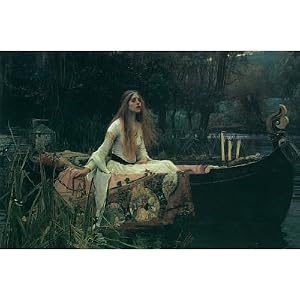
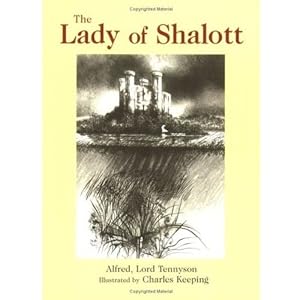
We had our first teatime this past week. We always start with the kids looking at poetry books and each pick a few to share or have me read. I usually try to highlight a more "serious" poet or poem. And we always finish with a choral reading of "The Crocodile's Toothache" by Shel Silverstein. This week I shared parts of an illustrated version of "The Lady of Shalotte" by Alfred Lord Tennyson. This poem is a Victorian ballad loosely based on the Arthurian legend of Elaine of Astolat. My only previous experience with "The Lady of Shalott" was the scene from Anne of Green Gables when Anne gets her self into trouble (again!) acting out the poem so I was interested to see what the poem is about. My brief synopsis: The Lady of Shalott lives in a tower next to a river that flows to Camelot. She spends her days in the tower weaving on a loom because she has been cursed and cannot directly look at the world but must view it through a mirror. However, she does look out and sees Sit Lancelot which prompts her to take a boat, write her name on it and float down the river towards Camelot where she dies along the way (of a broken heart?) Hmmmm. So much for uplifting content but it does certainly explain the scene from Anne of Green Gables. Below is the book we used and also "The Lady of Shalott" by John William Waterhouse.


Wednesday, February 10, 2010

More Snow Poems

Snow Flakes by Henry Wadsworth Longfellow

Out of the bosom of the Air

Out of the cloud-folds of her garments shaken,
Over the woodlands brown and bare,
Over the harvest-fields forsaken,
Silent, and soft, and slow
Descends the snow.

Even as our cloudy fancies take
Suddenly shape in some divine expression,
Even as the troubled heart doth make
In the white countenance confession
The troubled sky reveals
The grief it feels.

This is the poem of the air,
Slowly in silent syllables recorded;
This is the secret of despair,
Long in its cloudy bosom hoarded,
Now whispered and revealed
To wood and field.

The Snow Storm by Edna St. Vincent Millay


No hawk hangs over in this air:

The urgent snow is everywhere.
The wing adroiter than a sail
Must lean away from such a gale,
Abandoning its straight intent,
Or else expose tough ligament
And tender flesh to what before
Meant dampened feathers, nothing more.
Forceless upon our backs there fall
Infrequent flakes hexagonal,
Devised in many a curious style
To charm our safety for a while,
Where close to earth like mice we go
Under the horizontal snow.


Sunday, February 7, 2010

Snowstorm: February 2009


We looked upon a world unknown,
On nothing we could call our own.
Around the glistening wonder bent
The blue walls of the firmament,
No cloud above, no earth below, -
A universe of sky and snow!

From Snowbound by John Greenleaf Whittier

Thursday, February 4, 2010

The Sloth


THE SLOTH

In moving-slow he has no Peer.
You ask him something in his Ear,
He thinks about it for a Year;

And, then, before he says a Word
There, upside down (unlike a Bird),
He will assume that you have Heard -

A most Ex-as-per-at-ing Lug.
But should you call his manner Smug,
Hell sigh and give his Branch a Hug;

Then off again to Sleep he goes,
Still swaying gently by his Toes,
And you just know he knows he knows.


Theodore Roethke 1908-1963

Wednesday, December 2, 2009

Good bye Fall 2009

Painting is called "When Leaves Turn" by Grandma Moses

Autumn

by: Emily Dickinson (1830-1886)


The morns are meeker than they were,
The nuts are getting brown;
The berry's cheek is plumper,
The rose is out of town.

The maple wears a gayer scarf,
The field a scarlet gown.
Lest I should be old-fashioned,
I'll put a trinket on.


Thursday, April 23, 2009

God's Grandeur


The world is charged with the grandeur of God.
It will flame out, like shining from shook foil;
It gathers to a greatness, like the ooze of oil
Crushed. Why do men then now not reck his rod?
Generations have trod, have trod, have trod;
And all is seared with trade; bleared, smeared with toil;
And wears man's smudge and shares man's smell: the soil
Is bare now, nor can foot feel, being shod.

And for all this, nature is never spent;
There lives the dearest freshness deep down things;
And though the last lights off the black West went
Oh, morning, at the brown brink eastward, springs--
Because the Holy Ghost over the bent
World broods with warm breast and with ah! bright wings.

By Gerard Manley Hopkins

Monday, April 6, 2009

Abraham Lincoln by N.C. Wyeth


O CAPTAIN! my Captain! our fearful trip is done;
The ship has weather’d every rack, the prize we sought is won;
The port is near, the bells I hear, the people all exulting,
While follow eyes the steady keel, the vessel grim and daring:
But O heart! heart! heart! 5
O the bleeding drops of red,
Where on the deck my Captain lies,
Fallen cold and dead.

2

O Captain! my Captain! rise up and hear the bells;
Rise up—for you the flag is flung—for you the bugle trills; 10
For you bouquets and ribbon’d wreaths—for you the shores a-crowding;
For you they call, the swaying mass, their eager faces turning;
Here Captain! dear father!
This arm beneath your head;
It is some dream that on the deck, 15
You’ve fallen cold and dead.

3

My Captain does not answer, his lips are pale and still;
My father does not feel my arm, he has no pulse nor will;
The ship is anchor’d safe and sound, its voyage closed and done;
From fearful trip, the victor ship, comes in with object won; 20
Exult, O shores, and ring, O bells!
But I, with mournful tread,
Walk the deck my Captain lies,
Fallen cold and dead.

By Walt Whitman


Friday, March 27, 2009

Why Poetry?

Poetry resides at the intersection of
Thought and feeling
Shadow and light
Community and solitude

Poetry deals with the epic of things both
Great and small
Sober and light hearted
Exotic and familiar

Poetry gives us a glimpse of life stripped down to its barest essence and shows the seed of promise and beauty in all things- even misery.

To some, poetry is a just a train of words across the page that goes
on and on
on and on
on and on....

But to me it is a lyrical and rhythmic melody flown straight from the heart.

Sunday, March 8, 2009

Mr. Nobody

Mr. Nobody
I know a funny little man,
As quiet as a mouse,
Who does the mischief that is done
In everybody's house!
There's no one ever sees his face,
And yet we all agree
That every plate we break was cracked
By Mr. Nobody.

'Tis he who always tears our books,
Who leaves the door ajar,
He pulls the buttons from our shirts,
And scatters pins afar;
That squeaking door will always squeak,
For, prithee, don't you see,
We leave the oiling to be done
By Mr. Nobody.

He puts damp wood upon the fire,
That kettles cannot boil;
His are the feet that bring in mud,
And all the carpets soiled.
The papers always are mislaid,
Who had them last but he?
There's no one tosses them about
But Mr. Nobody.

The finger marks upon the door
By none of us are made;
We never leave the blinds unclosed,
To let the curtains fade.
The ink we never spill; the boots
that lying round you see
Are not our boots -- they all belong
To Mr. Nobody

Anonymous

Ha! Now I know where all those socks missing from the laundry went.
I find it interesting that this poem is by Anonymous.
(Maybe Mr. Nobody wrote it...!)

Thursday, March 5, 2009

Ode to Charlie


We had our cousin, Charlie, over for the past few days and in his honor we composed the following:

Ode to Charlie

Charlie likes to play
He likes to play all day
Char likes to clean
He is a sports machine
We are glad he came to stay!